
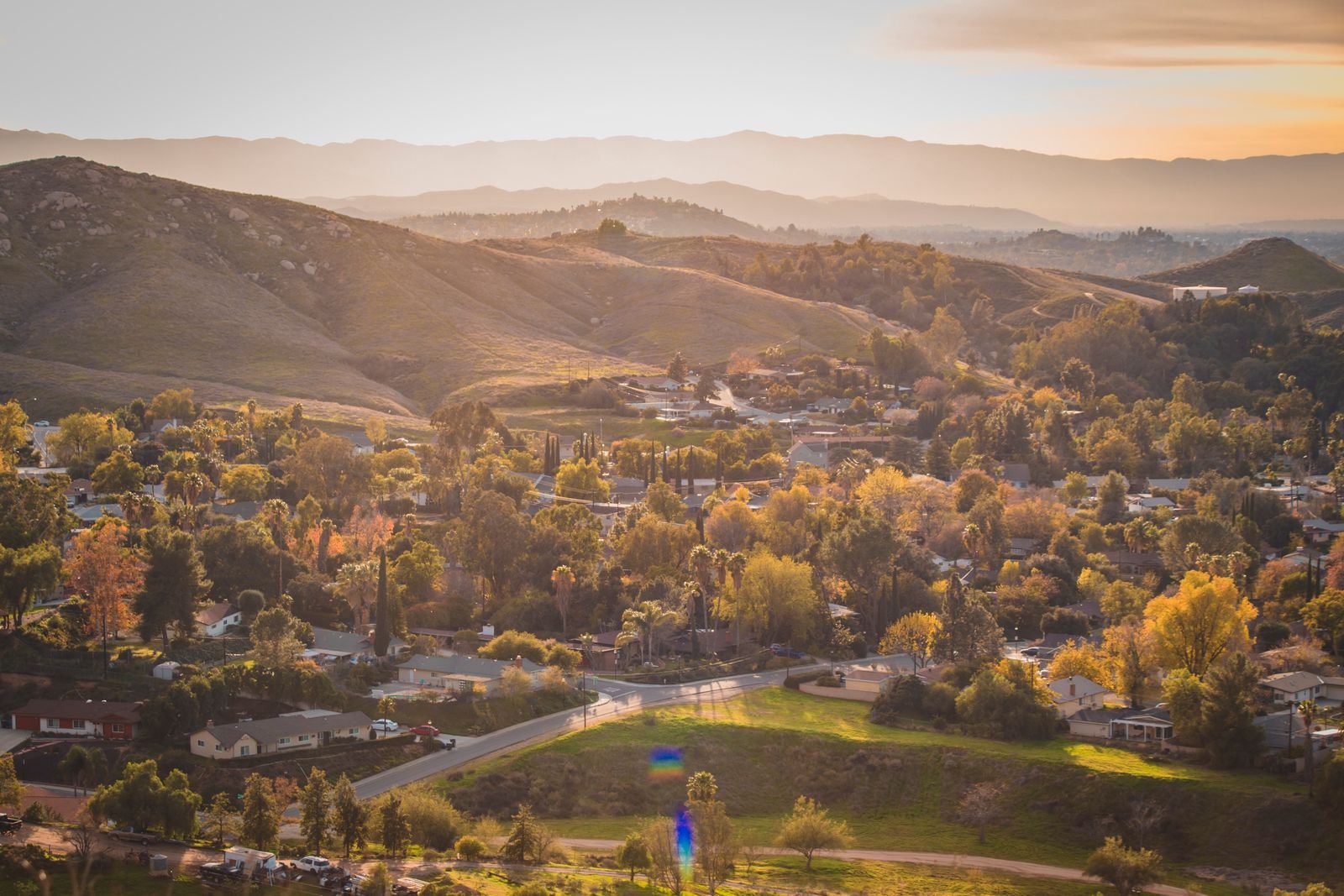

A practical guide for Simi Valley business owners on camera permits through the City's Building & Safety Division, California recording law, where cameras actually work on First Street lots and Easy Street tilt-ups, and when AI monitoring beats a guard.
Why Simi Valley businesses end up with cameras that do not help
Simi Valley is one of the safer cities in Ventura County, and that is exactly why many owners install cameras as an afterthought. Then a dealer on First Street loses a set of wheels overnight, a machine shop on Cochran Street finds the yard gate cut, or a store on Los Angeles Avenue gets hit through the rear door, and the police report asks for footage. The footage is grainy, the camera was pointed at the sky, or the recorder overwrote itself a week ago.
Usable footage in Simi Valley depends on three things that have nothing to do with the camera brand: California recording law, the City of Simi Valley permit process, and your landlord's rules if you lease. Get those right and the hardware is the easy part. This guide walks through each one the way a local contractor would explain it on a site survey.
California recording rules that apply in Simi Valley
Video recording of public-facing and business areas is legal in California. What is not legal is recording in places where people reasonably expect privacy, which under California Penal Code section 647(j) includes restrooms, locker rooms, changing areas and similar spaces. Keep cameras out of those entirely, including any angle that looks through a door into one.
Audio is the bigger trap. California Penal Code section 632 makes it a crime to record a confidential conversation without consent of all parties. Most business camera systems in Simi Valley should have audio recording turned off, or limited to areas with clear signage and no expectation of privacy. Two-way speakers used for AI monitoring voice-downs are fine, since the operator is speaking to someone on your property, not secretly recording a private talk.
Post signage. A sign at each entrance stating that the premises are under video surveillance costs almost nothing, supports your position if footage is ever challenged, and deters the casual thief before the camera has to do anything.
Permits through the City of Simi Valley Building & Safety Division
Camera permits in Simi Valley go through the Building & Safety Division of the Department of Environmental Services at City Hall, 2929 Tapo Canyon Road. The city accepts electronic permit submittals, and for most camera projects the question is whether the work involves new low-voltage wiring, new electrical circuits, or structural attachment.
- A few plug-in cameras on an existing outlet, inside your own suite: usually no permit.
- Cabled IP cameras with new low-voltage runs above the ceiling or along a tilt-up deck: a low-voltage permit is the norm.
- A new pole on a dealer lot, conduit on the exterior of a building, or a new circuit for a recorder: permit plus drawings.
- Anything that touches an exit door, such as access control tied to cameras: Building & Safety and Ventura County Fire both review egress.
A licensed C-7 contractor pulls the permit in their name and meets the inspector. If someone offers to install cameras in Simi Valley without a license or a permit, the risk lands on you at lease end, at sale, or when an insurance adjuster asks who did the work.
Landlord and property manager rules by building type
Most Simi Valley businesses lease, and the landlord's rules come before the city's. On the industrial side, in the parks off Madera Road, Cochran Street, Park Center Drive, Easy Street and Guardian Street, landlords generally allow cameras but prohibit roof penetrations and unapproved facade conduit. Wall mounts with cable run inside the building are the standard workaround.
In the offices on Tapo Canyon Road and around the Civic Center and Town Center, property managers want a certificate of insurance and a low-voltage plan before anyone opens a ceiling tile, and most require after-hours work. In the strip centers along Los Angeles Avenue and Tapo Street, the facade is the landlord's, so exterior cameras and conduit need written approval and often have to match the center's standard. Get approval in writing before permitting. The city will not resolve a landlord dispute for you.
Where cameras actually work on Simi Valley lots and tilt-ups
Placement is where most Simi Valley installs go wrong. A dealer lot on First Street needs a plate-reading camera at each driveway, mounted low enough and angled so headlights do not wash out the plate, plus overview cameras high on poles or building corners to see across the rows. The rear fence line, where lots back up to the 118 or side streets, is where most people actually enter.
A tilt-up on Easy Street or Cochran Street needs the man door, the roll-up, the dock and the yard gate, and a long view down each side yard. Mount at 10 to 14 feet: high enough to be out of reach, low enough to see faces. Add infrared or white-light illumination for the dark corners a streetlight does not reach. For a strip center suite, cover the register, the front door, the back door and your section of the lot.
Retention matters as much as placement. Thirty days is a reasonable minimum for a Simi Valley business, and dealers should keep longer. A locked rack for the recorder keeps a thief from taking the evidence with them.
When AI monitoring beats a guard or a recorded system
Recorded video helps after a loss. It does not prevent one. For businesses that are empty overnight, which includes almost every dealer, yard, warehouse and construction site in Simi Valley, AI camera monitoring adds a live response. Software flags a person or vehicle on the property after hours, a trained operator looks at the feed within seconds, and a voice-down through an outdoor speaker tells the intruder they are being watched and police are being called. If they stay, the operator calls Simi Valley police with a live description.
A single overnight guard covers one spot and costs a large monthly payroll. Monitoring covers every camera at once, from $1 per camera per day a month with the first month free, and it never falls asleep in a truck. Many owners keep daytime staff and use monitoring for the hours when the lot or yard is empty. The first month is a good test: you get the response logs and can judge for yourself.
A practical checklist for Simi Valley owners
Before you buy anything, walk the property at night and note where the light stops. Confirm with your landlord in writing what you can mount and where. Decide whether you need audio anywhere, and if not, turn it off. Plan retention and where the recorder lives. Then get a licensed C-7 contractor to draw the plan, pull the permit through the Building & Safety Division on Tapo Canyon Road, and install it to pass inspection.
ITECH2 does all of that in 93063 and 93065, from First Street lots to Guardian Street warehouses to the offices on Tapo Canyon Road. The site survey is free, and it is the single most useful hour you can spend before choosing cameras. Call (866) 904-8787 or email tech@itech2.co.
Questions Simi Valley businesses ask
Do I need a permit for security cameras at my Simi Valley business?
Usually yes if the installation involves new low-voltage wiring, exterior conduit, a pole or a new electrical circuit. The City of Simi Valley Building & Safety Division at 2929 Tapo Canyon Road handles it. Plug-in cameras on an existing outlet inside your suite generally do not need one. A licensed C-7 contractor pulls the permit and meets the inspector for you.
Can I record audio on my business cameras in California?
Only with care. California Penal Code section 632 prohibits recording confidential conversations without everyone's consent, so most Simi Valley businesses should keep audio recording off or limit it to clearly signed areas with no expectation of privacy. Two-way speakers used for live voice-down deterrence are fine, since that is an operator speaking to someone on your property.
Is AI camera monitoring worth it for a small Simi Valley business?
If your property is empty overnight and has anything worth taking outside, yes. Monitoring adds a live operator and a voice-down the moment someone enters, which stops most incidents before a loss. It starts at $1 per camera per day a month with the first month free, and it works with existing IP cameras in many cases. A free site survey tells you what you already have and what you need.
Free site survey in Simi Valley
ITECH2 is a licensed C-7 low voltage contractor serving Simi Valley since 2010. We will walk your property, tell you what you actually need and quote it in plain numbers — free.
Book a free Simi Valley site survey Call or text (805) 232-3088Related: Network Cabling in Simi Valley · Fiber Optic Installation in Simi Valley · Security Camera Installation in Simi Valley · AI Camera Monitoring in Simi Valley